
From Surviving to Thriving: What Earning My PhD Taught Me About Transformative Care at Work
This spring, I earned my doctorate in Education for Social Justice from the University of San Diego. Here is what my research means for the schools, hospitals, businesses, and nonprofits I am honored to partner with.
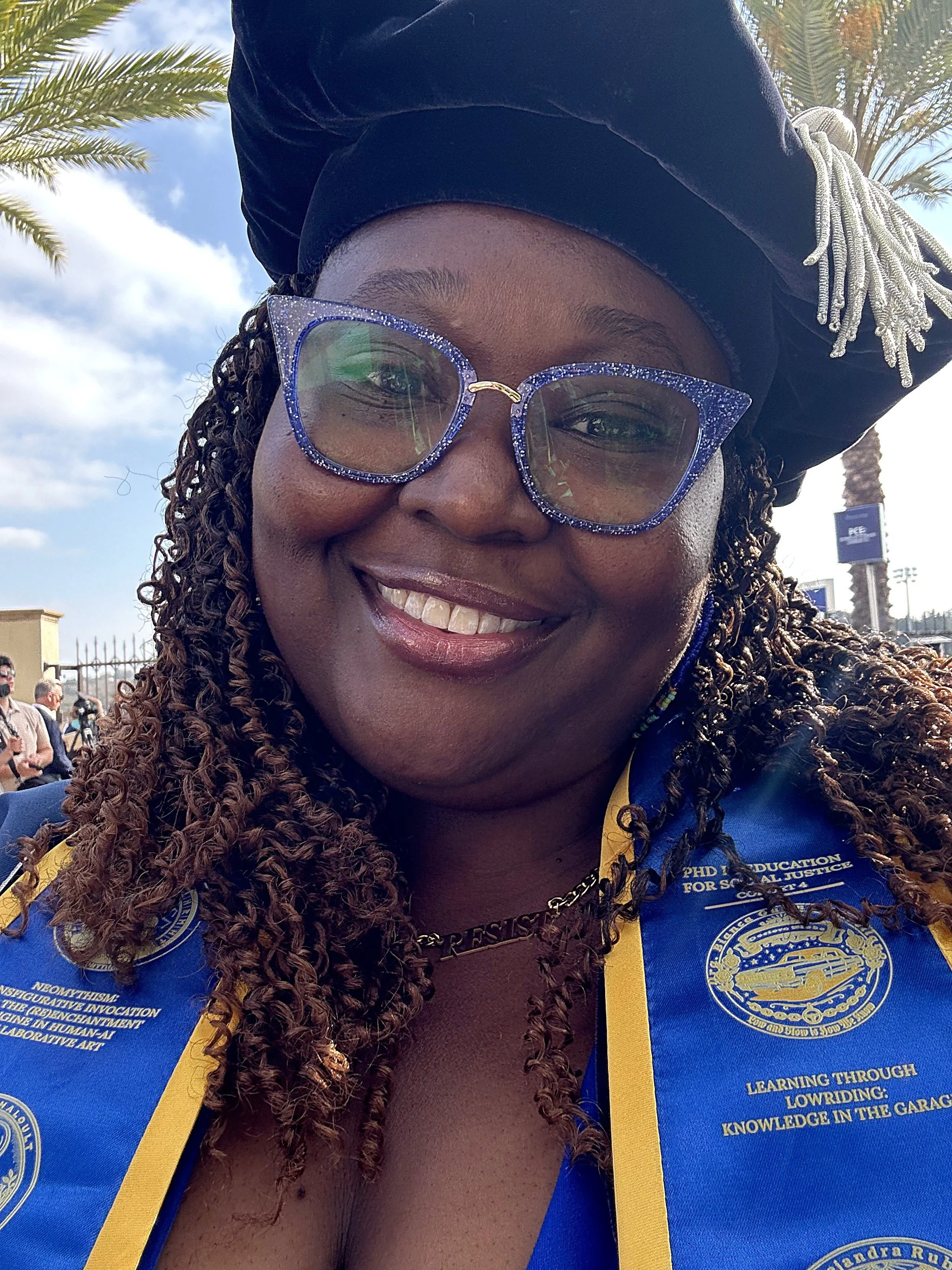
Image of Tanaisha with cap and gown at graduation.
This spring, I defended my dissertation, A Praxis of Transformative Care, and earned my PhD in Education for Social Justice from the University of San Diego. It is a milestone I have worked toward for years. I want to mark it not by talking about myself, but by sharing what the work is actually for, because the research that earned those three letters was never meant to live on a shelf. It was built to be used, in real organizations, by real leaders who want their people to do more than get by.
Here is the conviction at the center of my study: care is not a sentiment, a perk, or a personality trait. It is infrastructure. Organizations that build care into how they operate keep their people, earn their trust, and do better work. Organizations that leave it to chance lose all three, and often cannot explain why.
What transformative care actually means
Transformative care is the practice of changing institutions so that people can thrive inside them, rather than asking people to simply endure institutions that were never designed with them in mind.
At the heart of my dissertation is an idea I call the scaffold of sufficiency: the interconnected supports, relationships, and resources that allow people to move from surviving to thriving inside systems not built for them. I did not develop this concept alone. Over seven sessions, I worked alongside 8 collaborators (historically resilient students) whom I positioned as co-architects of change, not as research subjects. The people living the experience helped design the response to it.
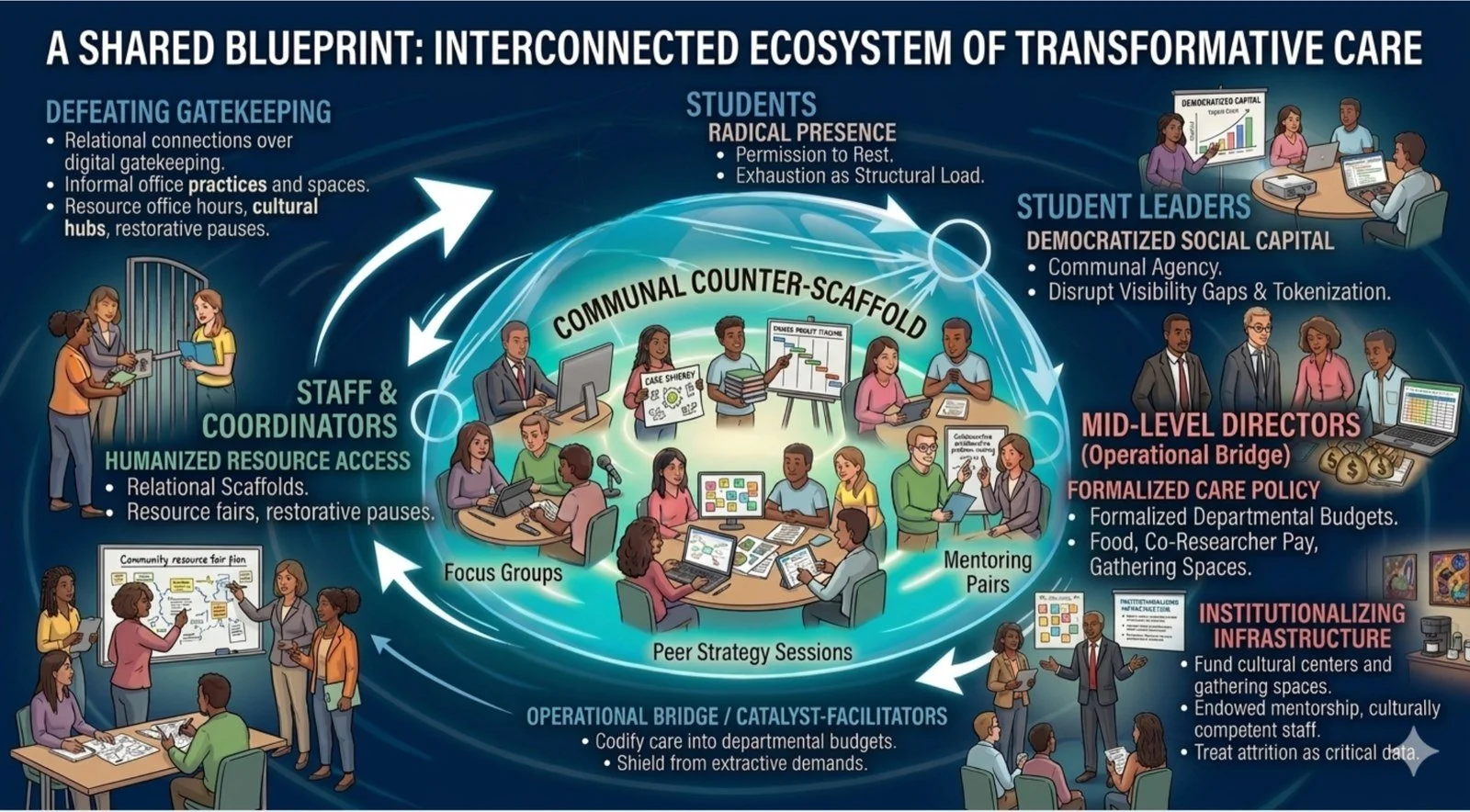
An image displays what a praxis of transformative care can tangibly entail.
The scaffold of sufficiency in practice: how well-being ripples outward through every level of an institution. From A Praxis of Transformative Care (Coleman, 2026).
Surviving is not thriving, and the difference is where organizations quietly succeed or fail. A team can hit every number and still be burning out. A student can graduate and still have felt invisible the whole way through. A hospital can be fully staffed on paper and still be losing trust at the bedside. Transformative care is how you close that gap, and it belongs in every industry, not only education.
Why this belongs far beyond the classroom
I built this work in education, but the pattern repeats everywhere people gather to do hard things. In healthcare, culture shows up in retention, in team communication, and in the experience patients carry home. In business, it shows up in engagement, collaboration, and whether your best people stay. In the nonprofit world, it shows up in whether a mission-driven team can live its values internally and not just deliver them outward. In the local community, it shows up in whether local organizations feel like places worth committing to. Different sectors, same human truth: people do their best work where they are supported, seen, and set up to succeed.
Below are four transferable takeaways from my research. Each one is something you can act on this quarter or next year, and each one is something we can build together.
1. Treat care as infrastructure, not personality
In most organizations, whether a person thrives depends on access. Access to the right information, the right relationships, and the unwritten rules that quietly decide who gets ahead. A nurse who knows which manager will actually advocate for her. An employee who happens to sit close to where decisions get made. A student who finds the one person willing to explain how things really work. When thriving depends on who you happen to know, support becomes a privilege instead of a practice, and the people who need it most are often the ones least able to reach it. The goal is to build access into the structure of the work, so belonging does not hinge on personality, proximity, or luck.
Start here: Map where thriving in your organization currently runs on informal access, the hidden rules, the well-placed mentor, the fortunate seat at the table, rather than on supports anyone can reach. Those gaps are where your people quietly fall through.
Work with TC Consulting: I lead structured learning sessions with an ongoing advisory committee, made up of people from across your organization and the different entities, that proactively works to integrate the recommendations into everyday practice. Instead of a report that sits on a shelf, you get a group that meets, learns together, and carries the changes into each department, so access becomes built in rather than left to chance.
2. The people closest to the problem are your co-architects
The most important lesson of my method is also the simplest. Solutions designed with people hold. Solutions designed for people to stall. My 8 collaborators were not surveyed and sent away. They helped shape the work, and the work was stronger and more durable because of it. Your frontline staff, your students, and your employees already know where the friction lives. The question is whether you have built a way to listen that they actually trust.
Start here: Choose one decision that affects your people and invite the people most affected into the design of it, not just the feedback on it afterward.
Work with TC Consulting: I facilitate focus groups and participatory planning that turn quiet knowledge into shared strategy. In one engagement, this approach moved staff feedback participation from 20 percent to 90 percent in a single year, because people contribute when they believe their input changes something.
3. Dynamically assess and adapt belonging and psychological safety efforts, then watch them move
Leaders often treat culture as too soft to measure. It is not. What gets named and tracked gets better, and what stays vague stays stuck. Psychological safety, belonging, and trust can be baselined, benchmarked, and revisited like any other priority. In one organization, deliberate, data-informed work lifted team psychological-safety ratings from 1 to 4 on a five-point scale within a year. This was a measurable shift that was managed and progressed.
Start here: Establish a baseline for psychological safety and belonging now, and set a date to measure it again. You cannot improve what you refuse to look at.
Work with TC Consulting: My cultural assessments produce concrete, prioritized findings rather than a vague verdict. For one hospital, a system-wide assessment of 155 staff responses became 14 specific recommendations leadership could act on immediately.
4. Build for sufficiency, so the work outlasts any single leader or policy climate
A one-time training feels productive and fades by the next quarter. A scaffold of sufficiency is designed to remain standing after the workshop ends, after leadership turns over, and after the policy weather changes. This matters in every sector, and it matters acutely in education right now, where the ground keeps shifting. The organizations that endure are the ones that treat culture work as a sustained practice with owners, checkpoints, and a plan, not a single event to check off.
Start here: Look at your last culture or training investment and ask one question. Six months later, what actually changed? If the honest answer is not much, you need a restructure, not an event.
Work with TC Consulting: Through strategic development planning, I help you turn good intentions into a sustainable plan, with the support and accountability that let real change last.
Let's build something brave
I did not earn this doctorate to become a more credentialed version of the same advice everyone already gives. I earned it to bring something specific to the table: a research-grounded way of moving organizations from performative compliance to genuine, lasting transformation. I know both the research and the room, and I tailor the work to the organization in front of me.
If you lead a school, a health system, a business, a nonprofit, or a community organization, and you want your people to move from surviving to thriving, I would welcome a conversation about what that could look like for you.
Reach me at tcc@tanaishacolemanconsulting.com, or learn more at tanaishacolemanconsulting.com. My dissertation is available open access via the following link: https://digital.sandiego.edu/dissertations/1096/.
Dr. Tanaisha Coleman, Ph.D., is the founder and lead consultant of TC Consulting, a Central Texas practice helping organizations build culture and belonging that last. She holds a PhD in Education for Social Justice from the University of San Diego, an M.S. in Organizational Development, and is a Certified IDI Administrator.